Efficient Modeling of Detectors for Far-IR Astronomy
J. Anthony Murphy, Stephen Doherty, Neil Trappe, Colm Bracken and Creidhe O'Sullivan
Extending microwave techniques enables design and precise prediction of the performance of telescope receivers for making high-sensitivity observations of faint astronomical sources of far-IR radiation.
9 December 2011, SPIE Newsroom. DOI: 10.1117/2.1201112.004039
Far-IR receivers typically employ bolometers, a type of highly sensitive detector that absorbs the power in the incoming astronomical signal. Typical sources in the far-IR waveband include galaxies in the early universe and the cosmic microwave background. To prevent unwanted radiation from reaching the bolometers, they are often embedded in an electrically conducting structure that efficiently collects the incoming astronomical signal beam from the telescope and guides it to the detector. The system is usually housed inside a vacuum chamber known as a cryostat, which maintains the bolometers at a very low temperature that is close to absolute zero.
It is important to be able to reliably model the full telescope-receiver system for optimal performance in obtaining sharp images, while also having the sensitivity to distinguish very faint features. Because of the relatively long wavelength of the far-IR signal compared to visible light, it is too simplistic to regard the beam as traveling purely in the form of rays. Instead, diffraction effects (or the bending that occurs when a wave is confined) as well as the electromagnetic nature of the signal beam become important when modeling transmission from the telescope through the receiver system to the bolometer.
In developing these models, we need to simulate two distinct sections of the beam path: first, inside the conducting metal waveguide structure and, second, over the path from the telescope where the beam travels essentially as a free-space (i.e., vacuum) wave. The free-space propagation requires a technique known as quasi-optical analysis, which takes into account the effects of diffraction, especially if there are lenses or focusing mirrors in the path of the beam from the telescope. The propagation inside the electrically conducting waveguide structure, on the other hand, requires an extension of microwave techniques and a novel theoretical approach.
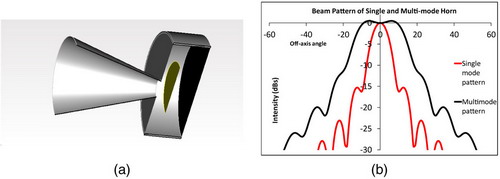
Figure 1. (a) A section through a far-IR detector pixel showing multimode horn, detector cavity, and bolometer (thin absorbing disk). (b) Increase in beam width (and throughput) for a multimode horn compared with a single-mode horn for the same aperture size (both beams normalized to 0dB on axis).
The microwave technique that we have applied is based on decomposing the propagating signal into component waveguide modes. In microwave systems, typically only one waveguide mode propagates, limiting the power transmitted while ensuring the fields have a coherent structure. However, in far-IR systems, we are often interested in improving sensitivity for faint signal detection by allowing many modes to propagate, thus significantly increasing the so-called throughput of the system. If the number of modes is not too large, an interesting regime arises in which microwave techniques can be efficiently applied to yield an accurate analysis of the system.
There are two critical issues for optimized performance: the reception pattern of the horn antenna, which collects the incoming signal beam from the telescope,1, 2 and efficient detection by the bolometer embedded in the waveguide structure,3 for example, a cavity fed by a multimode waveguide and horn antenna: see Figure 1(a). In analyzing such systems using a waveguide mode approach, the propagating modal fields are not in a definite phase relationship to each other.4 This leads to a more complex but tractable description compared with single-mode microwave systems, which we have reported on elsewhere.1
The multiple higher-order modes in the horn antenna and waveguide lead to beams with higher gain and larger widths: see Figure 1(b). Thus, more power incident on the aperture of the horn is collected compared with a single-mode system.1, 2 Typically, we model the bolometer as a thin conducting sheet with finite surface conductivity. The resulting lossy currents in the device are driven by the electric fields of the partially coherent signal, which must simultaneously satisfy the boundary conditions for magnetic fields. Consequently, we obtain a complete description of the multimode detector system, including beam patterns and optical efficiencies.3
Astronomical observation in the far-IR is critical for answering many important questions about the early universe and the formation and evolution of planets, stars, and galaxies. The development of sensitive astronomical receivers in this wavelength band is extremely challenging because unwanted background signals due to heat emission from the telescope and receiver system structures can easily overwhelm the faint astronomical signals. Extending microwave analytical techniques has made it possible to reliably model multimode detector systems to high accuracy. This will allow the design and development of more sensitive detector systems for future far-IR space and ground-based systems, as we are now proposing.3